


- This event has passed.
TILOS-HDSI Seminar: Safety, Representations, and Generative Learning in Dynamical Systems
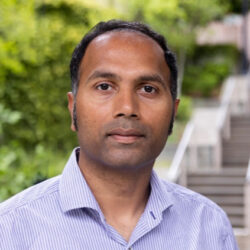
Koushil Sreenath, UC Berkeley
Abstract: This talk explores the interplay between model-based guarantees and learning-based flexibility in the control of dynamical systems. I begin with safety-critical control using control barrier functions (CBFs), highlighting that while CBFs enforce state constraints, they may induce unstable internal dynamics. I introduce conditions under which CBF-based safety filters ensure boundedness of the full system state. I then transition to learning representations of hybrid dynamical systems. I present a framework that learns continuous neural representations by exploiting the geometric structure induced by guards and resets, enabling accurate flow prediction without explicit mode switching. Finally, I discuss generative learning approaches for control, emphasizing guided diffusion models that jointly represent states and actions. Through applications to agile humanoid locomotion, motion synthesis, and dynamic manipulation, I demonstrate how generative models can produce versatile, long-horizon behaviors while respecting physical constraints. Together, these results highlight how structure, geometry, and learning can bridge safety guarantees and expressive control in complex dynamical systems.
Koushil Sreenath is an Associate Professor of Mechanical Engineering, at UC Berkeley. He received a Ph.D. degree in Electrical Engineering and Computer Science and a M.S. degree in Applied Mathematics from the University of Michigan at Ann Arbor, MI, in 2011. He was a Postdoctoral Scholar at the GRASP Lab at University of Pennsylvania from 2011 to 2013 and an Assistant Professor at Carnegie Mellon University from 2013 to 2017. His research interest lies at the intersection of highly dynamic robotics and applied nonlinear control. His work on dynamic legged locomotion was featured on The Discovery Channel, CNN, ESPN, FOX, and CBS. His work on dynamic aerial manipulation was featured on the IEEE Spectrum, New Scientist, and Huffington Post. His work on adaptive sampling with mobile sensor networks was published as a book. He received the NSF CAREER, Hellman Fellow, Google Faculty Research Award in Robotics, and Best Paper Awards at Learning for Dynamics and Control (L4DC) and Robotics: Science and Systems (RSS).