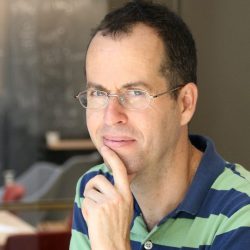
Elchanan Mossel, MIT Abstract: Classical Machine Learning theory is largely built upon the assumption that data samples are independent and identically distributed (i.i.d.) from general distribution families. In this talk, I will present novel insights that emerge when we move beyond these traditional assumptions, exploring both dependent sampling scenarios and structured generative distributions. These perspectives […]
TILOS Seminar Series
Calendar of Events
|
M
Mon
|
T
Tue
|
W
Wed
|
T
Thu
|
F
Fri
|
S
Sat
|
S
Sun
|
|---|---|---|---|---|---|---|
|
0 events,
|
0 events,
|
0 events,
|
0 events,
|
0 events,
|
0 events,
|
0 events,
|
|
0 events,
|
0 events,
|
0 events,
|
1 event,
-
|
0 events,
|
0 events,
|
0 events,
|
|
0 events,
|
0 events,
|
1 event,
-
Rebecca Willett, University of Chicago Abstract: Algorithmic stability holds when our conclusions, estimates, fitted models, predictions, or decisions are insensitive to small changes to the training data. Stability has emerged as a core principle for reliable data science, providing insights into generalization, cross-validation, uncertainty quantification, and more. Whereas prior literature has developed mathematical tools for […] |
0 events,
|
0 events,
|
0 events,
|
0 events,
|
|
0 events,
|
0 events,
|
1 event,
-
Jason Lee, Princeton University Abstract: The incredible success of transformers on sequence modeling tasks can be largely attributed to the self-attention mechanism, which allows information to be transferred between different parts of a sequence. Self-attention allows transformers to encode causal structure which makes them particularly suitable for sequence modeling. However, the process by which transformers […] |
0 events,
|
0 events,
|
0 events,
|
0 events,
|
|
0 events,
|
0 events,
|
0 events,
|
0 events,
|
0 events,
|
0 events,
|
0 events,
|