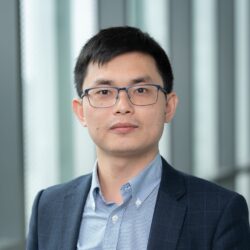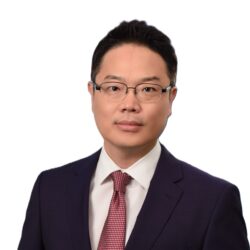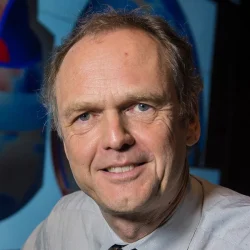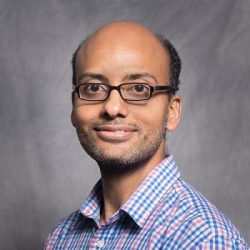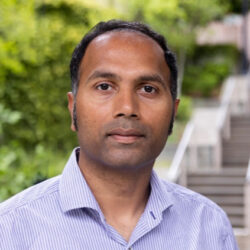
Koushil Sreenath, UC Berkeley Abstract: This talk explores the interplay between model-based guarantees and learning-based flexibility in the control of dynamical systems. I begin with safety-critical control using control barrier functions (CBFs), highlighting that while CBFs enforce state constraints, they may induce unstable internal dynamics. I introduce conditions under which CBF-based safety filters ensure boundedness […]
TILOS Seminar Series
Calendar of Events
|
M
Mon
|
T
Tue
|
W
Wed
|
T
Thu
|
F
Fri
|
S
Sat
|
S
Sun
|
|---|---|---|---|---|---|---|
|
0 events,
|
0 events,
|
1 event,
-
|
0 events,
|
1 event,
-
Tengyu Ma, Stanford Abstract: AdamW has long been the dominant optimizer in language model pretraining, despite numerous claims that alternative optimizers offer 1.4 to 2x speedup. We posit that two methodological shortcomings have obscured fair comparisons and hindered practical adoption: (i) unequal hyperparameter tuning and (ii) limited or misleading evaluation setups. To address these two […] |
0 events,
|
0 events,
|
|
0 events,
|
0 events,
|
0 events,
|
0 events,
|
1 event,
-
Yang Zheng, UC San Diego Abstract: Direct policy search has achieved great empirical success in reinforcement learning. Many recent studies have revisited its theoretical foundation for continuous control, which reveals elegant nonconvex geometry in various benchmark problems. In this talk, we introduce an Extended Convex Lifting (ECL) framework, which reveals hidden convexity in classical optimal […] |
0 events,
|
0 events,
|
|
1 event,
-
Sung-Kyu Lim, University of Southern California Abstract: Multi-chip integration has become a standard approach in AI training and is rapidly gaining traction in edge learning applications. Leveraging 2.5D and 3D IC architecture enables substantial improvements in energy efficiency and latency by optimizing inter chip data transfer. At the core of this transformation lies the automation […] |
0 events,
|
1 event,
-
Maarten de Hoop, Rice University Abstract: We present a kinetic theory perspective of foundation models for physics. We begin with providing a mathematical framework for analyzing transformers. To uniformly address their expressivity, we consider the case that the mappings are conditioned on a context represented by a probability distribution of tokens. That is, transformers become […] |
0 events,
|
0 events,
|
0 events,
|
0 events,
|
|
0 events,
|
0 events,
|
0 events,
|
0 events,
|
1 event,
-
Jason Eshraghian, UC Santa Cruz Abstract: This talk will show you what neuromorphic computing can do when an academic lab accidentally pulls $2-million of GPU-hours. We will showcase a series of frontier reasoning LLMs developed out of an academic lab, from data curation and pre-training to post-training and alignment. These models surpass leading LLMs from […] |
0 events,
|
0 events,
|
|
0 events,
|
0 events,
|
0 events,
|
0 events,
|
1 event,
-
Bharath Sriperumbudur, Pennsylvania State University Abstract: Wasserstein gradient flows have become a popular tool in machine learning with applications in sampling, variational inference, generative modeling, and reinforcement learning, among others. The Wasserstein gradient flow (WGF) involves minimizing a probability functional over the Wasserstein space (by taking into account the intrinsic geometry of the Wasserstein space). […] |
0 events,
|
0 events,
|